The Scientific Truth About St. John’s Wort: Benefits, Evidence, and Dangerous Drug Interactions
In the vast landscape of natural remedies, few herbs have sparked as much scientific interest and clinical debate as St. John’s Wort, known botanically as Hypericum perforatum. Widely celebrated as a natural alternative to conventional antidepressants, this bright yellow flower has been used for centuries to treat both physical wounds and emotional suffering.
However, in modern evidence-based medicine, St. John’s Wort is treated with a high degree of caution. While clinical trials show that it possesses genuine therapeutic properties, pharmacologists have also discovered that it is one of the most pharmacologically active and potentially dangerous herbal supplements on the market.
This comprehensive guide serves as an authoritative, science-based review of St. John’s Wort. We will examine its history, its active chemical compounds, what the clinical research says about its efficacy, and the critical drug-herb interactions that every doctor, pharmacist, and consumer must understand.
Table of Contents
- What Is St. John’s Wort? Botanical and Historical Background
- The Active Ingredients: How St. John’s Wort Works in the Body
- Clinical Evidence: Does It Really Work for Depression?
- Beyond Depression: Other Medical and Topical Applications
- The Primary Safety Threat: Critical Drug-Herb Interactions Explained
- Side Effects and Long-Term Safety Profile
- Smart Consumer Guidance: How to Choose and Use St. John’s Wort Safely
1. What Is St. John’s Wort? Botanical and Historical Background
St. John’s Wort is a perennial flowering plant native to Europe, western Asia, and northern Africa. Over the centuries, it has naturalized across many other parts of the world, including North and South America, Australia, and New Zealand. In some regions, such as Australia and the western United States, it is actually classified as an invasive weed because of its aggressive growth and its ability to cause sun sensitivity in grazing livestock.
Botanical Identity
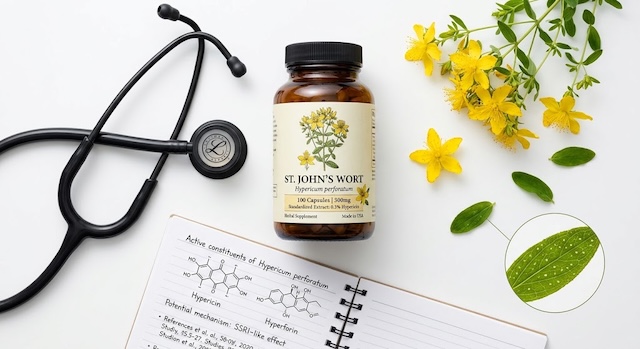
The plant grows between 30 and 90 centimeters tall and features distinctive bright yellow flowers with five petals. If you hold the leaves up to the light, you will see tiny, translucent spots that look like perforations. This unique feature gave the plant its species name, perforatum. These tiny dots are actually microscopic oil glands containing the plant’s bioactive essential compounds.
A Rich Historical Legacy
The common name St. John’s Wort relates to St. John the Baptist, as the plant traditionally blooms in late June, around the time of the feast of St. John on June 24. The word “wort” is an Old English term that simply means plant or herb.
The medicinal use of this plant dates back more than two thousand years. Ancient Greek physicians, including Dioscorides, Pliny the Elder, and Galen, documented using the herb to treat sciatica, burns, and wounds. During the medieval period, the herb took on a spiritual meaning, believed by many to ward off evil spirits and melancholia. The Swiss physician Paracelsus was among the first to recommend it specifically for psychiatric conditions, calling mental disturbances “phantasmata.”
In modern times, Germany spearheaded the clinical rediscovery of the herb in the 1970s and 1980s. German doctors integrated standardized extracts into their mainstream medical practice, and it became one of the country’s most frequently prescribed treatments for mild to moderate depressive episodes.
2. The Active Ingredients: How St. John’s Wort Works in the Body
Unlike refined pharmaceutical drugs that typically rely on a single chemical compound, herbal medicines contain dozens of active constituents that work together. St. John’s Wort features a highly complex chemical makeup with over 150 identified compounds. The primary active ingredients belong to three main classes:
Naphthodianthrones: Hypericin and Pseudohypericin
For decades, scientists believed that hypericin was the primary compound responsible for the herb’s antidepressant effects. Because of this, most commercial extracts are still standardized to contain exactly 0.3 percent total hypericins. However, modern research has shown that hypericin alone cannot explain the herb’s mood-elevating properties.
Hypericin is highly sensitive to light. It acts as a potent photosensitizer, meaning it can accumulate in the skin and generate highly reactive oxygen molecules when exposed to sunlight. This property is studied for photodynamic cancer treatments, but it also explains why taking high doses of the herb can lead to severe sunburns.
Phloroglucinol Derivatives: Hyperforin
Today, pharmacologists recognize hyperforin as the principal driver of the herb’s antidepressant activity. Hyperforin is a unique compound that acts as a broad-spectrum neurotransmitter reuptake inhibitor.
While common prescription antidepressants like selective serotonin reuptake inhibitors (SSRIs) focus primarily on serotonin, hyperforin inhibits the synaptic reuptake of five major brain chemicals:
- Serotonin
- Norepinephrine
- Dopamine
- Gamma-aminobutyric acid (GABA)
- L-glutamate
It achieves this broad-spectrum inhibition by activating specific calcium channels in brain cells, known as TRPC6 channels. When these channels open, they alter the delicate sodium and calcium balance within the neurons, reducing the efficiency of the transporters that normally clean up these neurotransmitters. This increases the concentration of mood-boosting chemicals in the brain.
Flavonoids and Biflavones
St. John’s Wort also contains a rich selection of flavonoids, such as quercetin, rutin, and amentoflavone. These compounds offer powerful antioxidant and anti-inflammatory benefits. Some specific flavonoids, such as amentoflavone, can bind to the brain’s GABA-A receptors, which may help explain why some users experience a reduction in anxiety.
3. Clinical Evidence: Does It Really Work for Depression?
Because of its massive global popularity, St. John’s Wort is one of the most thoroughly researched herbal supplements in history, evaluated in more than 80 randomized controlled clinical trials.
The Evidence for Mild to Moderate Depression
The overwhelming consensus of major systematic reviews, including multiple landmark Cochrane reviews, is that standardized extracts of St. John’s Wort are significantly more effective than a placebo for treating mild to moderate depression.
Furthermore, clinical trials comparing St. John’s Wort to standard prescription antidepressants, such as SSRIs, have shown that the herb is just as effective for mild to moderate depressive episodes. It also boasts a highly favorable safety profile in these trials, with significantly fewer side effects and lower patient dropout rates compared to conventional medications.
The Controversy: Why Some Trials Were Negative
Despite many positive trials, some large-scale clinical studies conducted in the United States reported negative results, showing no significant difference between St. John’s Wort and a placebo. This discrepancy has been heavily debated by the medical community. Several factors explain these conflicting findings:
- Depression Severity: Positive trials usually looked at mild to moderate depression, while the negative US trials enrolled patients with more severe major depressive disorders.
- Extract Quality: Different studies used different herbal brands with varying amounts of active hyperforin.
- Placebo Response Rates: The negative US trials often recorded unusually high placebo response rates, which made it difficult to prove that the herb was the active driver of recovery.
The current clinical consensus is clear: St. John’s Wort is a viable, evidence-based option for mild to moderate depression, but it should not be used as a treatment for severe major depression.
4. Beyond Depression: Other Medical and Topical Applications
While emotional health remains its most famous application, clinical researchers have evaluated St. John’s Wort for several other health concerns:
Premenstrual Syndrome (PMS) and Menopause
Because of its ability to influence serotonin pathways, some clinical trials suggest that St. John’s Wort can help relieve both the physical and emotional symptoms of PMS. It is also frequently combined with other herbs, such as black cohosh, to treat hot flashes, anxiety, and sleep disturbances during menopause.
Topical Wound Healing and Eczema
In folk medicine, St. John’s Wort flowers are steeped in olive oil to create a deep red oil known as Oleum Hyperici. Today, science supports this traditional use. Studies have shown that topical preparations of St. John’s Wort can stimulate cells called fibroblasts to produce collagen, which accelerates wound healing.
Furthermore, hyperforin has been shown to possess powerful antibacterial properties, particularly against Gram-positive bacteria like Staphylococcus aureus, which commonly colonize the skin of individuals suffering from eczema or atopic dermatitis.
5. The Primary Safety Threat: Critical Drug-Herb Interactions Explained
If St. John’s Wort is highly effective and generally well-tolerated, why do health authorities worldwide issue strict warnings about its use? The answer lies in its ability to interfere with other medications.
St. John’s Wort is a master of drug interactions. The active compound hyperforin is a potent activator of a specific receptor in the liver and intestines known as the Pregnane X Receptor (PXR). When hyperforin binds to PXR, it sends a signal to the body to produce a massive amount of drug-metabolizing enzymes and transport proteins.
This process, known as enzyme induction, dramatically accelerates the rate at which the body breaks down and clears other medications. As a result, the active level of other drugs in your bloodstream can drop below therapeutic levels, making them completely useless.
The Most Dangerous Drug Interactions
St. John’s Wort interacts with an estimated 50 percent of all prescription medications. Some of the most critical and life-threatening interactions include:
- Immunosuppressants: St. John’s Wort can reduce blood levels of critical transplant drugs, such as cyclosporine and tacrolimus, by up to 70 percent. This has led to documented cases of acute organ transplant rejection.
- Oral Contraceptives: The herb speeds up the clearance of estrogen and progestin, which can lead to breakthrough bleeding and unplanned pregnancies.
- Anticoagulants: It reduces the blood-thinning effects of warfarin and newer direct oral anticoagulants, significantly increasing the risk of blood clots and stroke.
- Antiretroviral Medications: It can reduce the efficacy of HIV medications, leading to viral rebound and the development of drug-resistant viral strains.
- Chemotherapy: It reduces the levels of key cancer-fighting drugs, such as irinotecan and imatinib, potentially compromising cancer treatment.
- Serotonergic Antidepressants: Combining St. John’s Wort with SSRIs, SNRIs, or triptans can cause an additive effect, leading to a rare but life-threatening condition called Serotonin Syndrome, characterized by rapid heart rate, high blood pressure, muscle twitching, and confusion.
Because enzyme induction requires the synthesis of new proteins, these interactions take about one to two weeks to develop after you start taking St. John’s Wort, and they can persist for up to two weeks after you stop taking the herb.
6. Side Effects and Long-Term Safety Profile
When used as a standalone treatment at the standard recommended dosage, St. John’s Wort is highly tolerable, with an adverse reaction rate of only 0.1 to 5.7 percent. However, users should be aware of several potential side effects:
Photosensitivity
Because of the light-sensitive nature of hypericin, some users may experience increased sensitivity to sunlight. This can result in severe sunburns, skin redness, or blistering, even after brief sun exposure. Anyone taking the herb should apply sunscreen and avoid tanning beds.
Psychiatric and Neurological Effects
While rare, St. John’s Wort can trigger manic or hypomanic episodes in individuals with undiagnosed bipolar disorder. This is a risk shared by all conventional antidepressants. Abruptly stopping the herb after long-term use can also trigger mild discontinuation symptoms, such as dizziness, nausea, and anxiety.
Pregnancy and Breastfeeding
The safety of St. John’s Wort during pregnancy and lactation has not been established. Because hyperforin and hypericin are excreted in breast milk, breastfeeding mothers should avoid using this supplement.
7. Smart Consumer Guidance: How to Choose and Use St. John’s Wort Safely
If you and your healthcare provider decide that St. John’s Wort is a suitable option for your health, follow these guidelines to ensure maximum safety and efficacy:
Dosing and Administration
The standard therapeutic dose for mild to moderate depression is 900 milligrams per day of standardized extract, typically split into three doses of 300 milligrams taken with meals. It is crucial to remember that like conventional antidepressants, St. John’s Wort does not work immediately. It typically takes two to four weeks of consistent use before you notice any improvement in your mood.
Product Selection
The supplement market is highly unregulated, and studies show that many commercial brands contain wildly varying levels of active ingredients. To protect your health:
- Look for standardized extracts calibrated to contain 0.3 percent hypericins.
- Select brands that carry a Good Manufacturing Practice (GMP) seal or have been verified by reputable third-party testing organizations.
- Consider low-hyperforin extracts if you are concerned about drug interactions, though you should discuss this strategy with your doctor first.
The Washout Period
If you need to switch from St. John’s Wort to a conventional prescription antidepressant, you must observe a washout period of at least one to two weeks to prevent dangerous drug interactions and protect your nervous system.
Conclusion
St. John’s Wort is a powerful testament to the therapeutic potential of nature. It is backed by robust clinical evidence proving its worth in fighting mild to moderate depression. Yet, its potent biological activity serves as a vital reminder: natural does not always mean safe. By working closely with a medical professional and understanding its complex pharmacology, you can safely harness the benefits of this remarkable plant.
References:
- Linde, K., Ramirez, G., Mulrow, C. D., Pauls, A., Weidenhammer, W., & Melchart, D. (1996). St John’s wort for depression—an overview and meta-analysis of randomised clinical trials. British Medical Journal, 313(7052), 253–258. DOI: 10.1136/bmj.313.7052.253
- Linde, K., Berner, M. M., & Kriston, L. (2008). St John’s wort for major depression. *Cochrane Database of Systematic Reviews*, (4), CD000448. DOI: 10.1002/14651858.CD000448.pub3
- Szegedi, A., Kohnen, R., Dienel, A., & Kieser, M. (2005). Acute treatment of moderate to severe depression with hypericum extract WS 5570 (St John’s wort): randomised controlled double blind non-inferiority trial versus paroxetine. *British Medical Journal*, 330(7490), 503. DOI: 10.1136/bmj.38356.655266.82
- Hypericum Depression Trial Study Group. (2002). Effect of Hypericum perforatum (St John’s wort) in major depressive disorder: a randomized controlled trial. *JAMA*, 287(14), 1807–1814. DOI: 10.1001/jama.287.14.1807
- Shelton, R. C., Keller, M. B., Gelenberg, A., et al. (2001). Effectiveness of St John’s wort in major depression: a randomized controlled trial. *JAMA*, 285(15), 1978–1986. DOI: 10.1001/jama.285.15.1978
- Piscitelli, S. C., Burstein, A. H., Chaitt, D., Alfaro, R. M., & Falloon, J. (2000). Indinavir concentrations and St John’s wort. *The Lancet*, 355(9203), 547–548. DOI: 10.1016/S0140-6736(99)05712-8
- Müller, W. E. (2003). Current St. John’s wort research from mode of action to clinical efficacy. *Pharmacological Research*, 47(2), 101–109. DOI: 10.1016/S1043-6618(02)00266-9
- Gastpar, M., Singer, A., & Zeller, K. (2006). Comparative efficacy and safety of a once-daily dosage of hypericum extract STW3-VI and citalopram in patients with moderate depression: a double-blind, randomised, multicentre, placebo-controlled study. *Pharmacopsychiatry*, 39(2), 66–75. DOI: 10.1055/s-2006-931544
- Kasper, S., Anghelescu, I. G., Szegedi, A., Dienel, A., & Kieser, M. (2006). Superior efficacy of St John’s wort extract WS 5570 compared to placebo in patients with major depression: a randomized, double-blind, placebo-controlled, multi-center trial. *BMC Medicine*, 4, 14. DOI: 10.1186/1741-7015-4-14
- Apaydin, E. A., Maher, A. R., Shanman, R., et al. (2016). A systematic review of St. John’s wort for major depressive disorder. *Systematic Reviews*, 5(1), 148. DOI: 10.1186/s13643-016-0325-2